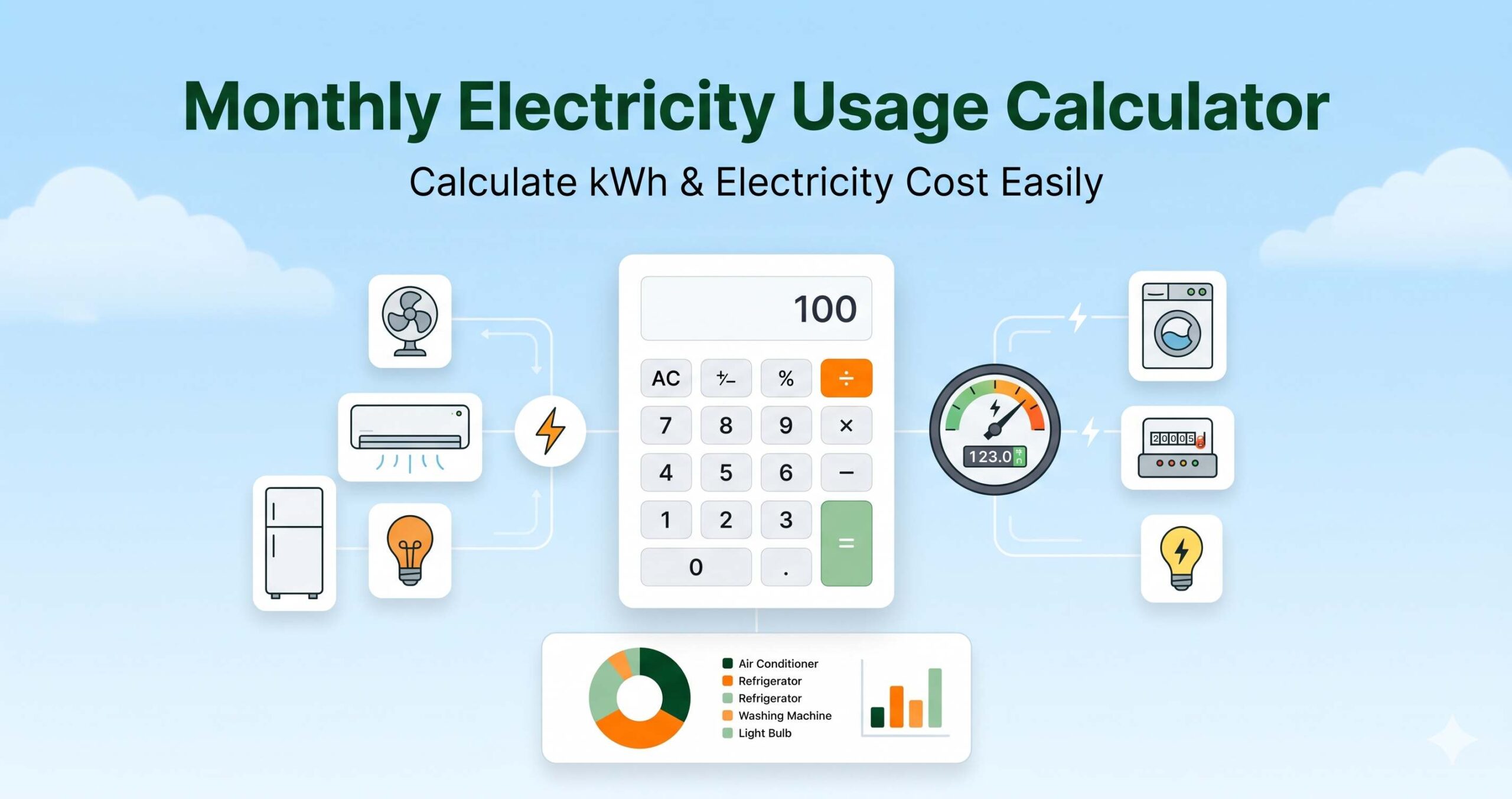
Monthly Electricity Usage Calculator
Calculate your monthly electricity consumption, estimate your bill, and discover ways to save energy with our free online tool.
Electricity Bill Calculator
Add your appliances and calculate your monthly electricity usage
Understanding Electricity Flow
Basic Electrical Circuit
Electricity flows from the power source through the appliance, and energy consumption is measured by the meter in kilowatt-hours (kWh).
Energy Calculation Flow
What is Monthly Electricity Usage?
Monthly electricity usage refers to the total amount of electrical energy consumed by your household or business over a billing period, typically 30 days. This measurement is recorded in kilowatt-hours (kWh), which represents the energy used when a 1000-watt appliance runs for one hour. Understanding your monthly electricity consumption helps you manage your energy costs effectively and identify opportunities for savings.
Every electrical appliance in your home contributes to your monthly electricity usage. From small devices like phone chargers and LED bulbs to major appliances like air conditioners, refrigerators, and water heaters, each device adds to your total consumption. The key factors that determine how much electricity an appliance uses include its power rating (measured in watts), how long you use it each day, and how many days per month it operates.
What is a Monthly Electricity Usage Calculator?
A Monthly Electricity Usage Calculator is a free online tool designed to help you estimate your electricity consumption and calculate your expected monthly electricity bill. Our calculator allows you to input multiple appliances with their individual power ratings, daily usage hours, and monthly operating days. It then computes the total energy consumption and estimated cost based on your local electricity rate.
This electricity bill calculator provides instant, accurate calculations without requiring any technical knowledge. Whether you want to understand your current electricity usage, plan for a new appliance purchase, or compare energy costs between different devices, this calculator serves as your comprehensive energy planning tool. The visual pie chart helps you identify which appliances consume the most electricity, enabling smarter decisions about energy efficiency.
Electricity Calculation Formula
The formula used for calculating electricity consumption is simple and universally accepted:
Why is Tracking Electricity Usage Important?
Tracking your electricity usage offers numerous benefits for both your wallet and the environment. When you understand exactly how much energy each appliance consumes, you can make informed decisions about when and how to use them. This awareness often leads to significant cost savings on your monthly electricity bills.
Beyond cost savings, monitoring your electricity consumption helps reduce your carbon footprint. Electricity generation is a major source of greenhouse gas emissions. By using energy more efficiently, you contribute to environmental conservation and help combat climate change. Additionally, understanding your usage patterns can help you identify faulty appliances that may be consuming more power than they should, allowing for timely repairs or replacements.
How Electricity Calculation Works
The electricity calculation process involves converting the power rating of an appliance (measured in watts) into energy consumption (measured in kilowatt-hours). Here is a step-by-step breakdown of how our calculator determines your electricity usage:
- First, the calculator takes the power rating of each appliance in watts. This information is usually found on a label attached to the appliance or in its user manual.
- Next, it multiplies the watts by the number of hours the appliance is used each day. This gives the daily watt-hours consumed.
- The calculator then multiplies this figure by the number of days the appliance is used per month to get monthly watt-hours.
- Finally, it divides by 1000 to convert watt-hours to kilowatt-hours (kWh), which is the standard unit for electricity billing.
- The cost is calculated by multiplying the total kWh by your electricity provider’s rate per unit.
Real-Life Example: Calculating AC Electricity Cost
Example: 1.5 Ton Air Conditioner
Let us calculate the monthly electricity cost for a 1.5 ton air conditioner:
- Power Rating: 1800 watts (1.5 kW)
- Daily Usage: 8 hours
- Monthly Usage: 30 days
- Electricity Rate: 7 per kWh
Calculation: (1800 x 8 x 30) / 1000 = 432 kWh per month
Monthly Cost: 432 x 7 = 3,024
Energy Saving Tips to Reduce Your Electricity Bill
Implementing simple energy-saving practices can significantly reduce your monthly electricity consumption. Here are proven strategies that can help you save money while maintaining comfort:
Use Natural Light
Open curtains during the day to reduce the need for artificial lighting. This simple habit can save up to 10% on your lighting costs.
Optimize AC Settings
Set your air conditioner to 24-26 degrees Celsius. Each degree lower increases energy consumption by 6-8%.
Use Off-Peak Hours
Run heavy appliances like washing machines and dishwashers during off-peak hours when electricity rates may be lower.
Regular Maintenance
Clean AC filters and refrigerator coils regularly. Dirty appliances consume up to 15% more electricity.
Switch to LED
Replace old bulbs with LED lights. LEDs use 75% less energy and last 25 times longer than incandescent bulbs.
Unplug Devices
Unplug chargers and devices when not in use. Standby power can account for 5-10% of your electricity bill.
Benefits of Tracking Electricity Usage
Regular monitoring of your electricity consumption provides several advantages that extend beyond simple cost savings. Understanding your usage patterns empowers you to make better decisions about energy consumption, appliance purchases, and home improvements.
- Budget Planning: Predict your monthly electricity bills with accuracy and plan your finances accordingly.
- Identify Inefficiencies: Spot appliances that consume excessive power and consider upgrades or repairs.
- Compare Tariffs: Evaluate whether switching to a different electricity provider or plan could save you money.
- Environmental Impact: Reduce your carbon footprint by optimizing energy consumption.
- Smart Home Decisions: Make informed choices about new appliances based on their energy efficiency ratings.